Wednesday, September 3, 2014

Motherson Sumi Systems: Buy from Jain Matrix

Motherson Sumi Systems is an Indian auto ancillary firm that is growing rapidly through global acquisitions. It cut its teeth as a Maruti Suzuki vendor, then expanded capabilities, product lines and customer base. In recent years it bought undervalued global plants and rapidly turned them around, and now has operations in 25 countries, supplying to all major auto firms. Revenues, EBITDA and Net profits have grown at 77%, 57% and 20% CAGR over the last 5 years. The current high debt should be reduced soon to comfortable levels. MSS is a BUY at current levels.

Description and Profile

  • Motherson Sumi Systems (MSS) is a Noida UP based Auto Ancillary firm operating in 25 countries.
  • FY13 consolidated Revenues were Rs 25,200 cr, EBITDA 1,798 cr and Net Profit 451 cr.
  • The flagship of the Samvardhana Motherson group, MSS consolidates business with Samvardhana Motherson Peguform (SMP) and Samvardhana Motherson Reflectec (SMR), owns 51% of both. MSS is a JV with Sumitomo Wiring Systems (Japan), and has JVs with Japanese, German and U.K. firms.
  • Vivek Chand Sehgal is the Vice Chairman of MSS. The shareholding pattern in % is: Promoters is 65.6% (Indian 40 & Foreign 25.6) FIIs 17.2, DIIs 7.8, Individuals (Retail/HNI) 5.8, and Others 3.6%.

Business Notes

Business Segments
Fig 1 – Business Segments
  • MSS is a major supplier of components, modules and systems to the auto industry globally. These include Polymer Components, Mirrors, Wiring Harness and Rubber & Metal products. Fig 1.
  • The diversified customer base includes most dominant Auto firms. Fig 2.
Customers
Fig 2 – Excellent Customer Base
  • The company offers products in both automotive and non-automotive segments. However non-automotive is very small at about 2%.
  • In non-automotive segment, the company is the largest supplier to industrial forklifts and material handling manufacturers. It also manufactures and assembles water purifier for HUL in India.

Strategies and Events

  • MSS has strong customer relationships and is focused on increasing its Content Per Car. It is mostly the OEM supplier, and this simplifies the Auto company’s vendor management process.
  • Revenues from overseas operations in MSS consolidated grew to 83% (FY13) from 66% (FY11). MSS expanded its global operations and acquired undervalued assets, with 9 acquisitions in 10 years.
  • Post-acquisition of loss making auto ancilliary assets, the MSS management was extremely focused on a plant by plant turnaround, which has been the main reason for MSS success.
  • But the international focus hasn’t hurt the company’s local operations, which are growing fast and setting up new plants. MSS is a key supplier to Hyundai, Maruti Suzuki, M&M and Tata Motors. The domestic auto sector slump did not affect it as exports posted a 25% growth.
  • MSS has an excellent de-risking strategy – the growth should happen such that no Single Customer, Single Country or Single Commodity should constitute more than 15% of the turnover.
  • According to the plan of MSS, by 2015 the company will become a $5b company, increase the global presence to 27 countries, and achieve a ROCE of 40%. It is already close to achieving many of these targets.
  • In May’12, an IPO of Samvardhana Motherson Finance, a group firm, was withdrawn due to poor investor response. MSS is the only India listed firm from this group.

Stock Evaluation, Performance and Returns

The price history of MSS is mapped here.
  • After the 2008 economic slowdown MSS share price fell to a low of 25. It has been on a steady recovery path to a recent Feb 2014 price of 231.
  • In 5 years, the share price has appreciated at 50% CAGR, providing excellent returns to investors.
  • Three bonus issues in the last 7 years (and 4 in last 10) have also accelerated the returns.
Financials
Fig 3 – Quarterly Sales, Margins and EPS
  • Revenues, EBITDA and Net profits have grown at 77%, 57% and 20% CAGR over the last 5 years.
  • The quarterly financials of MSS Fig 3, reveal periodic surges in revenues, due to new acquisitions. In 2009, Visiocorp became a part of MSS (renamed SMR). In 2011, Peguform was acquired (SMP).
  • Margins are on recovery path, along with a massive growth in volumes, reflecting in the adjusted EPS.
  • MSS has been investing heavily in its operations, Fig 4, even so it is enjoying good Cash flow from Operation, and a positive Free Cash Flow.
  • Dividends have steadily increased over the last 6 years. Including bonuses, it is up almost 3.5 times.
Cash Flow
Fig 4 – Cash Flow & Dividend – Standalone
Price and PE_1
 Fig 5 – Price and PE movements
  • The Price and PE chart, Fig 5, reveals the variations in PE values along with the steady share price appreciation. In the last 5 years, the PE ratio has been in a range of 15-35 times, while this historical average is 25 times.
  • Today it is at 29 times, on the upper half of this range.
  • In the Price and EPS chart, Fig 6, we can see a sharp surge in EPS over the last 2 years. The share price has also been in line with this. The EPS growing within a channel represented by two lines.
EPS_1
Fig 6 – Price and EPS movements
  • Total debt is Rs 4071 cr, and D/E high at 1.78. However this is a spike, required to acquire firms, and is expected to be reduced to manageable levels in the next 1-2 years.
  • Return on Capital Employed is 17.4% while Return on Net Worth is 19.4%. These are good ratios.
  • PE is 29.6 currently, and PEG based on PE and EPS growth is at 0.98 – indicates a fairly valued stock.

Benchmarking

In the benchmarking exercise we compare MSS with industry plays like Bharat Forge, Bosch and Exide.
Benchmarking
Fig 7 – Industry Benchmarking
  • With its acquisitions in the recent past, MSS leads in terms of revenue growth. The cost of acquisitions reflects in the high debt.
  • With good cash management, the revenue growth should soon reflect on the profits and debt reduction. Good inventory turnover means factory assets are being well utilized.

Financial Estimate

The business financials are projected in Fig 8.
Projections
Fig 8 – Financial Projections
  • In the next 2-3 years, MSS will consolidate its acquisitions, steady the new operations, grow business volumes and repay debt from cash flows.
  • The recent revenues jumps will soon translate into profit increases.
  • MSS forex revenues is a plus as the INR over 2-3 years will be stable or may even depreciate a little.

Risks

  • Current expectations are that the domestic market’s current slowdown will end in 1-2 quarters, but if it extends for a longer period, domestic investments will be affected.
  • Foreign Exchange volatility. MSS has 83% of revenues in non INR currencies. A significant portion of debt is also in Forex. We can see large unpredictable quarterly gains and losses due to this.
  • Economic environment needs to be stable in key markets of USA, UK, Europe, China and India.
  • Complex corporate structure of group with many cross holdings, JVs and subsidiaries across firms.

Opinion, Outlook and Recommendation

  • The global automobile market recovered significantly in 2013 from the impact of the global financial crisis, buoyed by economic recovery and pent-up demand in the U.S. and Asia.
  • The automobile sector in India has many unique advantages – good local small car demand and production, export momentum, presence of many global names and design skills. Clearly the auto ancilliary industry also incorporates all of these.
  • MSS is a visible, dynamic player in auto ancillaries. They started as a vendor for Maruti Suzuki, and built capability, corporate maturity and finally global growth from this strong base.
  • By all indications, MSS is a successful Indian auto ancillary firm that has made bold moves to grow internationally, acquire technologies, listen to their customers and manage manufacturing well.
  • While the PE at 29.6 appears high, we expect profits growth to exceed this over the next 2-3 years
  • MSS is a buy with a Mar 2016 price target of 451, a 104% appreciation from today (25 Feb’14).
Source: http://jainmatrix.com/2014/02/26/blockbuster/

Charlie Munger’s Investing Principles

“If you can get good at destroying your own wrong ideas, that is a great gift.” – Charlie Munger
Warren Buffett famously ran a partnership for a small group of investors before turning Berkshire Hathaway into his investment vehicle of choice. He produced extraordinary results for himself and his investors.

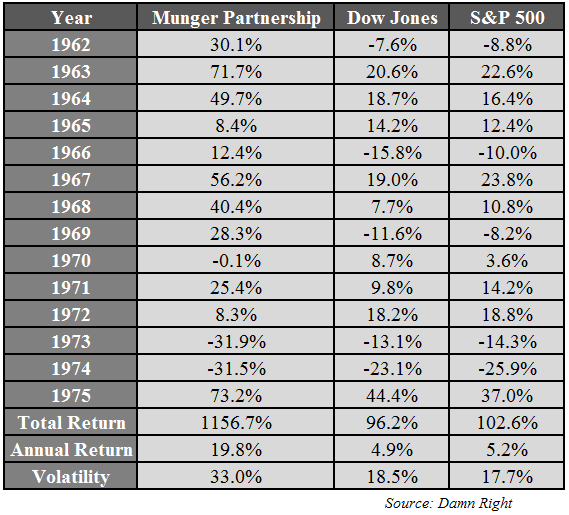
Many don’t realize this but his business partner Charlie Munger actually ran his own investment partnership as well. Here are Munger’s annual returns measured against the Dow and S&P 500 from inception until the fund was closed down:
Munger
The fund’s performance was stellar but you’ll notice it ran into some trouble in the 1973-74 bear market when the partnership was down over 53% while the Dow fell around 33%. Here’s Munger’s take on losses from the Janet Lowe’s book Damn Right: Behind the Scenes with Berkshire Hathaway Billionaire Charlie Munger:

I’ve been through a number of down periods. If you live a long time, you’re going to be out of investment fashion some of the time.
The volatility in the fund, as measured by the standard deviation of returns, was roughly double that of the market. Should that matter as long as the results were superior? Munger doesn’t think so:


This great emphasis on volatility in corporate finance we regard as nonsense. Let me put it this way; as long as the odds are in our favor and we’re not risking the whole company on one throw of the dice or anything close to it, we don’t mind volatility in results. What we want are favorable odds.


My take on volatility is that it’s only a risk if it causes an investor to forgo their process in favor of investing based on an emotional state of fear or greed. Otherwise volatility creates opportunities for patient investors.

Many in the investment industry tout their strategy as the only way to invest successfully. Munger would be on the short list of investors that could legitimately make this claim based on his track record. Instead he has a more nuanced take for finding a process that suits each individual’s unique tolerance for risk and their own personality:

Each person has to play the game given his own marginal utility considerations and in a way that takes into account his own psychology. If losses are going to make you miserable – and some losses are inevitable – you might be wise to utilize a very conservative patterns of investment and saving all your life. So you have to adapt your strategy to your own nature and your own talents. I don’t think there’s a one-size-fits-all investment strategy that I can give you.
There are no easy answers in the financial markets. There will never be a single technique that suits every individual. You must be willing and able to follow any specific approach.

Investing can be hard work. This is especially true for those that try to beat the market. It’s not impossible, but it’s not easy. Munger shared his thoughts on whether that means most investors should simply use index funds:

Does that mean you should be in an index fund? Well, that depends on whether or not you can invest money way better than average or you can find someone who almost surely will invest money way better than average. And those are the questions that make life interesting.
Regardless of your strategy, Munger makes it clear that having a long-term orientation with minimal activity can be a huge advantage:

There are huge advantages for an individual to get into position where you make a few great investments and just sit back. You’re paying less to brokers. You’re listening to less nonsense…If it works, the governmental tax system gives you an extra one, two, or three percentage points per annum with compound effects.
A relentless reader, Munger believes that any good investor should spend the bulk of their time in the pursuit of knowledge and understanding:

I don’t think you can get to be a really good investor over a broad range withoutdoing a massive amount of reading.
Finally, Munger is a fan of putting long-term systems and processes in place at Berkshire Hathaway that don’t require constant oversight by himself or Buffett:

Berkshire’s assets have been lovingly put together so as not to require continuing intelligence at headquarters.
It’s simple, but never easy.

Source: http://awealthofcommonsense.com/charlies-munger-becoming-better-investor/

Art Williams quote

“I’m not telling you it’s going to be easy – I’m telling you it’s going to be worth it.” ― Art Williams

Tuesday, September 2, 2014

Varanasi: smart city in the making

For many, Varanasi is about salvation — its ghats, temples and narrow, dingy bylanes give the spiritually oriented a mystical high. These days, however, India's oldest town is on a high itself as it turns into a real estate hotspot, buoyed by Prime Minister Narendra Modi's promise of making it a 'smart city'.

A top executive of an international realty consultant says he has been receiving frantic calls from his hotel clients in the past few days, enquiring about land prices and possible deals in the city.

Builders creating land banks in city

Among them is EIH Ltd, owner of the Oberoi hotels, which plans to build a luxury property there. PRS Oberoi, the 80-year-old chairman of the group that boasts of properties such as Udaivilas in Udaipur and Vanyavilas in Ranthambore, says: "Varanasi doesn't have enough good hotels. It makes a lot of sense to go there... There is more and more interest in the city now because of the recent announcements," he says.

Oberoi isn't the only one eyeing business in the city. American hotel chain Starwood's India head Dilip Puri says he has asked his development team to visit the city and scout for opportunities. "We are looking for partners... There is potential for both, domestic and international business," adds Lokesh Sabharwal, vice-president for the Indian sub-continent for French hotel chain Accor.

Property brokers say prices of land in and around the city have already started to rise with builders and investors beginning to create land banks. One biswa (1,360 sq ft) of land in areas such as Mohan Sarai on the outskirts, which was priced at Rs 12 lakh three months ago is now going for Rs 15 lakh, a rise of 25%. A broker says a bungalow he sold for Rs 2.5 crore in Ravindrapuri, the neighbourhood where the PM has set up his local office, is getting quoted forRs 3.25 crore since a month it was sold.

Investors and moneyed people from Bihar, UP and Haryana are on the lookout for land on the city's outskirts hoping they will sell them for a profit to builders as well as hoteliers as development rolls in. Delhi-based builder Amrapali says it has hastened plans to construct a township on the outskirts of the city after Varanasi was declared one of 100 smart cities the Modi government proposed to build. Last week, Modi signed an agreement with Shinzo Abe to have Kyoto as a partner in the development of Varanasi, which is represented in the Parliament by the PM.

The Japanese town, which is also known as the 'city of ten thousand shrines', has been redeveloped into a modern city while keeping its temples intact. Modi wants Varanasi to learn from that experience. Local property brokers say announcements such as these have raised the curiosity of people and there has been a spurt in interest from investors in Uttar Pradesh and from neighbourings states of Bihar and Haryana, and even from distant Hyderabad and Mumbai, "I've shown land to several small investors from Haryana and UP in the last two months.

They want to buy land and sell them later as plots. They know land is still cheap on the outskirts," says property broker Harish Jaiswal, who runs Satyam Property Dealers in the city. Another broker VK Singh, who operates from the Nadesar area of Varanasi says people from Hyderabad and Mumbai have been visiting to look at opportunities to set up commercial and industrial projects around the city, closer to the airport.

Right after the elections, Singh got enquiries from people looking to build hotels and colleges around Varanasi. A CEO of a real estate firm in Gurgaon, who did not wish to be named, says Varanasi is the talk of the town today especially in the real estate circles. "People have confidence in what the Japanese can do. They are hopeful of a transformation."

While the city itself might be congested, brokers say it has ample opportunity to expand on two sides— on the 22-kilometre road between the city and the airport and on the highway to Allahabad. Jaiswal says even locals are stirring up the action. Last month, he sold a bungalow built on 3,200 sq ft of land (or around 355 sq yards) for Rs 2.5 crore to a local businessman. Now the new owner is getting offers the buy the house at a much steeper prices—Rs 3.25 crore.

That's a neat 30% jump in one month riding on the back of all the euphoria. The potential is huge. "Varanasi can be a big centre for silk trading. If just one or two infrastructure and other cleaning activities start, the city will be on fire," says Ajay Mangal, director and chief executive officer of Delhi real estate firm MG Housing, which is in the process of buying 500 acres around Varanasi towards the airport for a future mixed-use development.

Noida-based builder Amrapali, which already has several projects in adjoining Bihar, is close to finalising a deal for buying a large chunk of land to build a township in Varanasi, says Shiv Priya, executive director of the company. For hotels, the lure is manifold. While there is hope that business travel will rise, untapped potential of the Buddhist circuit, of which it is the Centre and the city's ghats and temples is a big draw.


Source:http://economictimes.indiatimes.com/markets/real-estate/news/pm-narendra-modis-promise-to-develop-varanasi-into-smart-city-turns-it-into-realty-hotspot-overnight/articleshow/41463908.cms

UBI declares Mallya wilful defaulter

United Bank of India (UBI) on Monday declared Kingfisher Airlines and its chairman Vijay Mallya (pictured) wilful defaulters for non-payment of Rs 400 crore of dues. Three company directors — Subhash R Gupte, Ravi Nedungadi and Anil Kumar Ganguly — also figure in the list. The grounded airline company described the bank’s move as “post-haste”.

The bank’s grievance-redress committee on wilful default on Monday met at its Kolkata headquarters. “No representative from the airline company attended the meeting. The committee deliberated on the written submission of the company, examined the documents and directed the bank to declare Kingfisher Airlines and its directors wilful defaulters,” UBI Executive Director Deepak Narang told Business Standard.

Kingfisher Airlines had moved the Calcutta High Court two months after the bank had in May identified it and Mallya as wilful defaulters. The court last week dismissed the plea, paving the way for UBI to declare the company and its chairman wilful defaulters.

“Kingfisher Airlines has been demanding that UBI permit it to have legal representation of its choice at the hearing to be held before the grievance-redress committee set up by the bank. The basis for the demand is that being declared a wilful defaulter entails serious consequences, including penal action. So, depriving Kingfisher Airlines of an opportunity to be represented by a trained legal professional is denial of real and reasonable opportunity to the company to defend itself and a violation of the principles of natural justice,” the company said.

A single-judge Bench and the division Bench of the Calcutta High Court, through orders dated July 10 and August 28, had respectively dismissed a writ petition and an appeal filed by Kingfisher Airlines against UBI’s move. On August 29, the company had filed a special leave petition before the Supreme Court against the orders of high court.


"In the meantime, even before a copy of the order dated August 28 passed by the court was made available to the parties, and even before the special leave petition filed by Kingfisher Airlines was listed before the Supreme Court, UBI post-haste proceeded to purportedly declare the airline company and its directors/former directors wilful defaulters in respect of an overdraft facility of Rs 7.5 crore,” the company said. According to the Reserve Bank of India’s (RBI’s) guidelines, a wilful default is a situation where an entity has the capacity to repay its dues but chooses not to do so, or uses the borrowed money for purposes other than those for which a loan was availed of. For instance, if a borrower uses short-term working capital funds for long-term purposes or deploys the borrowed money for creation of assets other than those for which the loan was sanctioned, it is considered diversion of funds and the borrower is classified as a wilful defaulter. “We had asked Vijay Mallya and other Kingfisher Airlines directors to appear before our grievance-redress committee. But they wanted to be represented by lawyers and moved the court. We did not agree because we were relying on simple banking documents and statements of the company. There was no need for lawyers to be part of the grievance-redress committee meeting,” said a banker familiar with the development.

Bankers said they found “enough evidence” of the ability of Kingfisher Airlines and its group companies to repay the money borrowed from the bank. “At the time of taking the loan, Kingfisher Airlines had agreed to pledge its properties as securities.

When it defaulted, banks tried to recover their dues by selling some of those properties. As a good borrower, it should have helped banks in the process. But it has been putting obstacles and preventing sale of the assets by filing court cases. Also, United Breweries Holdings is the corporate guarantor for the loans. While the company has been raising money, it has not made any effort to repay even part of the loan,” said a banker.

UBI has informed RBI, Credit Information Bureau India Ltd and the Securities and Exchange Board of India of its decision to declare Kingfisher Airlines and its directors wilful defaulters. The move will prevent Mallya and other directors from availing of fresh loans and they, according to bankers, would also have to step down from the boards of different companies. Kingfisher Airlines said it intended to pursue all available legal remedies, including through the special leave petition filed before the Supreme Court.

India Inc: Neck deep in debt

India Inc's debt has been rising at an alarming rate. Yet, it hasn’t translated into productive assets for many. Read about the companies that are sinking and those that are sailing merrily

Recently, steelmaker Bhushan Steel was in the news after the company’s Vice-Chairman and Managing Director was arrested on charges of bribing the Syndicate Bank chief to extend fresh loans to it and prevent the bank from declaring the company’s existing loans as delinquent.

A forensic audit has now been ordered into the company’s books to verify if the borrowed money was used for the right purposes.

But don’t dismiss this as a one-off incident. Many members of India Inc are in much the same boat as Bhushan Steel, not in terms of corruption charges, but on the state of their finances which triggered this episode.

The issue of banks continuing to extend loans to over-leveraged companies has become a systemic concern. Debt at leveraged companies as well as the banks’ stock of bad loans have been rising at a scorching pace in the last five years.

The great divide

In the boom years of 2008 to 2010, Indian companies, fresh out of the credit crisis, lined up aggressive expansion plans believing that the uptick in the economy would stretch on for a while.

Firms in the core sectors of the economy took on significant loans to fund a ramp up in capacities for steel, mining, power generation and infrastructure projects.

But as the revival gave way to a renewed downturn, the rosy projections went awry. Policy and judicial activism and lack of raw materials also stalled a number of big-ticket projects midway, locking up funds of many large corporates in the core sectors.

Consider this. In the last five years, long-term debt of 966 NSE-listed companies has simply soared, growing by about 30 per cent annually. But fixed assets of these companies — to augment which these funds were raised in the first place — have grown by just 15 per cent during the same period.

The growth in debt has been particularly sharp between 2007 and 2008 and 2011-12, when it grew by almost 40 per cent annually. But growth in fixed assets slowed down considerably from 29 per cent in 2008-09 to 13-19 per cent in the subsequent years.

This also ties in with the findings of the Economic Survey. When India’s economy was firing on all cylinders between 2003 and 2008, capital spending by the corporate sector kept pace. But post-2008, corporate investments as a proportion of GDP have fallen to 9 per cent from 14 per cent during the boom phase of 2005 to 2008.

Studying the balance sheets of firms, it is clear that only half of the long-term funds raised every year were actually used for purchase of fixed assets since 2009. It is hence no surprise that some companies with huge debt are struggling to meet interest obligations — the slow pace of addition to capacities has meant that cash flows haven’t kept up with interest obligations. This has hit the profitability of these companies.

Infrastructure, iron and steel, mining and textiles sectors had the most stalled projects, and the difference between growth in loans and fixed assets is more pronounced in these sectors.

Here’s a look at these troubled sectors in detail.

Infrastructure in a debt spiral

Infrastructure is one of the sectors that contributes significantly to the level of stressed loans within the banking industry. About 18-20 per cent of the total loans given to this sector are under stress (bad loans and restructured assets).

Policy uncertainties stemming from difficulties in land acquisition, delayed environmental clearances and infrastructure bottlenecks have stalled many projects and shrunk the cash flows of companies burdened by debt. This reduced capital expenditure down to a trickle.

Our sample reveals that the construction and infrastructure sector has a 14 per cent share in the total long-term debt pie of India Inc. While long-term loans extended to this sector grew by about 44 per cent annually in the last five years, the growth in fixed assets has been much lower at 27 per cent.

In the last two years, the addition to fixed assets has been even slower — 18 per cent in 2012-13 and 8 per cent in 2013-14.

While investors have been gung-ho about the new Government’s pro-business agenda, and driven many infrastructure stocks up in the recent rally, the poor state of finances of some of the companies within the sector doesn’t support this optimism.

While most companies within the infra space have a high debt-to-equity ratio (DER), there are some worse-placed than others.

Take for instance, GVK Power, GMR Infra and JP Associates. Each of these companies has a high DER of five-seven times, and added debt at a much faster pace than fixed assets. GVK Power Infrastructure’s long-term debt has risen seven-fold from 2008-09, while fixed assets have expanded only four-fold.

More worrying, the company’s interest cost has risen about 30-fold from 2008-09, and the company has reported losses at the PBT (profit before tax) level for the second year in a row.

JP Associates has seen its interest cost shoot up by 50 per cent annually in the last five years. Gayatri Projects, Era Infra, IL&FS Transport, and Hindustan Construction are others that have added debt at a much faster pace than fixed assets. Hindustan Construction saw its long-term borrowings grow by about 31 per cent annually since 2009, but its fixed assets grew by 20 per cent.

A quick turnaround in most of these companies is unlikely, given that they are struggling to pay off their older debt obligations. As the companies struggle to complete existing projects, they may face difficulty in adding to their order books by participating in new bids.

However, there are a few infra companies that have managed to contain their debt burden. L&T and Adani Ports have DER of less than two times, and their growth in debt more or less ties in with the asset growth.

Sadbhav Engineering and IRB Infra too have been able to grow their assets 30-40 per cent annually over the last five years in tandem with the growth in debt. While their DER isn’t low at three to four times, both score on order book and execution strength.

Power in for a long haul

Power is another sector that is neck deep in debt. This sector constitutes a fifth of the total long-term loans with India Inc. The debt extended to this sector has grown 31 per cent annually since 2008-09. Fixed assets have however grown by just 20 per cent. The sector’s problems range from lack of fuel to power up plants to un-remunerative tariffs. As a result, many companies have been unable to service their debt obligations.

While Lanco Infratech saw its long-term debt and fixed assets grow by 46 per cent annually in the last five years, it had a debt equity ratio of 24 times in 2013-14.

Recently, the company sold its thermal power plant to Adani Power to trim its debt. While this will help repay some of its huge debt, the sale effectively deprives it of a primary cash-generating asset. This may not augur well in the long term.

There are others such as Adani Power and KSK Energy Ventures that saw their loans grow 45-65 per cent annually since 2008-09. Their fixed assets grew 40-50 per cent.

Most power plants have been operating below production capacity due to lack of availability of coal and gas needed to run these plants. Policy action from the Government to fix the problem of fuel shortage can help kick-start coal- and gas-fuelled power projects.

However, there are a few companies in the power sector that are better placed. Torrent Power, for instance, has a DER of 1.4 times. Its debt has grown by 22 per cent annually in the last five years, while fixed assets have grown by 19 per cent.

JSW Energy is one other player that has a DER of 1.4 times, and its long-term debt has grown by just 9 per cent annually in the last five years.

While Reliance Power scores well on a lower DER (1.4 times) , that the company’s loans have grown by 87 per cent in the last five years against 56 per cent growth in fixed assets may need a watch.

While Tata Power has a higher DER, its debt has grown by a moderate 18 per cent in the last five years backed by 16 per cent growth in assets. The recent Supreme Court order declaring all allocations of coal blocks since 1993 as illegal is likely to exacerbate the shortage of fuel for power plants in the short term.

Metals and power companies that depend on coal to run smelters and generate electricity may be in for a rough ride. It may be best to avoid power stocks for now, particularly ones that have a huge debt burden, till more clarity emerges on the recent order.

Hard times

With the Bhushan Steel episode, steel manufacturers, mining and metal players are suddenly at the centre of the debt maelstrom. Bhushan Steels’ long-term debt is now more than thrice the levels in 2008-09. While the company has grown its fixed assets too, delay in commissioning these capacities has led to the company struggling to meet debt obligations.

Interest costs have shot up by 45 per cent annually in the last five years, while its profit before tax is less than a fifth of that reported in 2008-09.

Electrosteel Steels, which has a DER of more than five times, has seen debt grow 41 per cent annually since 2010 (IPO in 2010), compared to 29 per cent growth in fixed assets. The company has been reporting losses at the PBT level since its IPO.

JSW Steel and Tata Steel, however, are better placed within this pack. Both have a DER of less than two times. JSW Steel’s debt and fixed assets have grown at 16-17 per cent annually in the last five years. Tata Steel’s debt grew at a modest 1 per cent in the last five years, while fixed assets have grown by about 9 per cent during the period.

The recent order on coal allocations is likely to impact mining companies. Post the recent order, companies such as Jindal Power and Steel, Hindalco and Sesa Sterlite may be the worst impacted.

Other sectors to watch for

The aviation sector has been another big source of stressed loans for banks, but for very different reasons.

High aviation fuel cost, weak passenger traffic leading to price discounts, high aircraft maintenance costs and airport charges have seen airline players incur huge losses.

After taking a big knock on the loans given to the ailing Kingfisher Airlines, banks are also grappling with credit extended to other players. The poor performance of Jet Airways in 2013-14 has only eroded its net worth further, which is a negative ₹4,175 crore.

Many key sectors and stocks mentioned above have rallied on hopes of a revival and expectations of reforms. But it may be best to avoid companies with weak finances.

These companies are likely to focus on trimming their debt, when earnings recover with the economy — rather than invest aggressively in new projects.

Source: http://www.thehindubusinessline.com/features/investment-world/neck-deep-in-debt/article6367132.ece

How to go about land grabbing